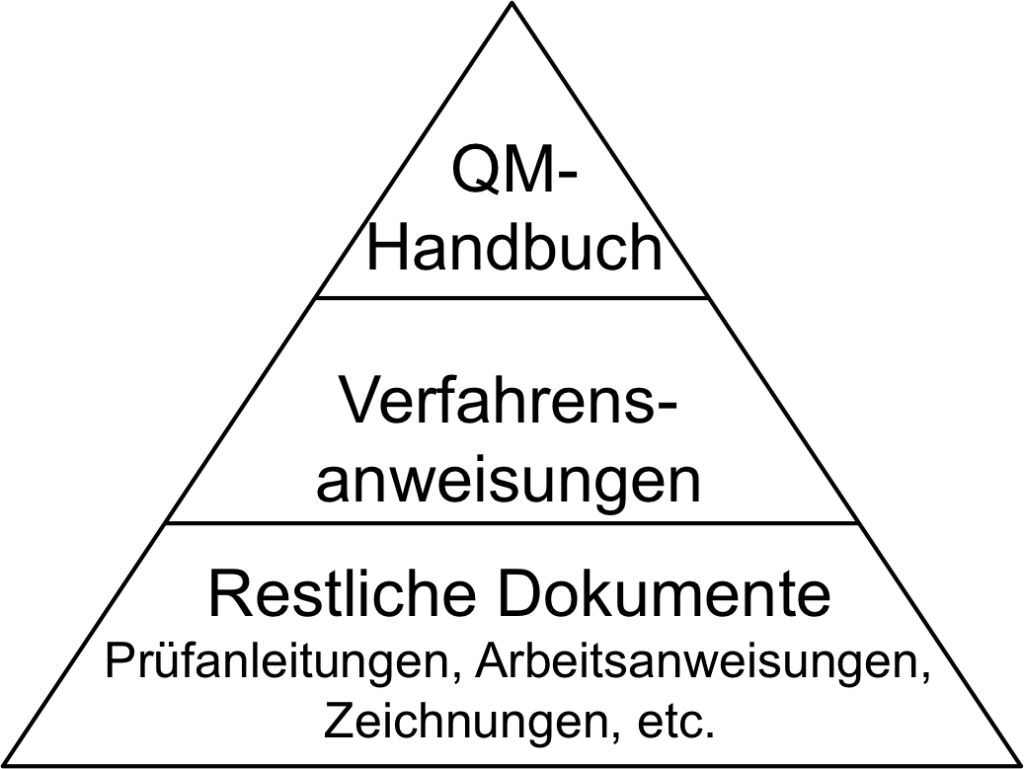
The QM manual, often abbreviated as QMH, is the top document in the document pyramid of the QM system. It serves as an entry point for employees and auditors to get a quick overview of the QM system.
In this article you will find out when you need a QM manual, what goals it pursues and what content it should contain.
You will also find a template to download in this article.
1. QM manual: goal and purpose
The QM manual is intended to serve as a central entry point for people who want to get to know the entire QM system, such as employees, auditors and customers. The manual is intended to convey:
- Overview of the contents and structure of the QM system
- “Philosophy”, the values and quality policy of the company
- Interaction of processes
Since the QM manual does not yet describe any trade secrets such as specific procedures (but only references them), some companies pass the QM manual on to customers.

2. Contents of the QM manual (QMH)
a) Overview
The QM manual typically contains global specifications, in particular the quality policy and the quality goals. There is also an overview of
- the organizational structure of the company,
- the document structure of the QM system and
- the roles that are filled within this QM system (but does not name any specific people).
In some cases, companies integrate the procedural instructions into the QM manual.
b) Example of chapter structure
The Johner Institute regularly uses the following chapter structure for its customers’ QMH in its customer projects:
- Purpose
- Scope, Responsibility & Exclusions
- a) Scope
- b) Responsibility
- c) Applicable standards, guidelines & laws
- d) Exclusions & Non-Application
- About Us
- a) Our company
- b) Our quality policy and quality goals
- c) Our organization & roles
- Structure of the QM documentation
- a) Quality management manual
- b) Procedural and work instructions
- c) Other specification documents
- d) Records
- Processes
- a) Process overview & interaction
- b) Leadership processes
- c) core processes
- d) Supporting processes
- General rules
- a) Internal Communication
- b) Property of the customer
- Attachment
- a) Relevant Documentation
- b) Glossary
3. Regulatory requirements
a) MDR, IVDR
The EU medical device regulations MDR and IVDR require a quality management manual (QMH) in Annexes IX (e.g. in Section 2.2):
Implementing the quality management system ensures compliance with this regulation. All details, requirements and precautions provided by the manufacturerfor its quality management system are documented systematically and orderly in the form of a quality manual and written principles and procedures such as quality assurance programs, plans and reports.
MDR Anhang IXSection 2.2.
b) ISO 13485
ISO 13485 also insists on such a thing in Chapter 4.2.2 of the same name (“Quality Management Manual”). It must regulate:
- Scope (including exclusions)
- Procedure (can also be done through references)
- Description of the interactions of the processes
- Structure of the documentation
4. Tips for the QM manual
a) Avoid typical mistakes
“No, I don’t think so“, some QM representatives answer when asked whether the manual would ever be read.
This means that quality management has become a completely useless institution that even hinders the actual work. A look at the QM manual makes it clear why no one wants to read this manual.
- Meaningless QM goals
The company wants satisfied customers!? Really!? That should go without saying. But what makes this company special? What can it do better than the competition? What do customers actually value? - Unspecific and incomplete
The business activities say that medical software is being developed. That’s not surprising for a company that develops medical software. Is there also support? Does she run the application herself? Does she conduct training? Customer installations? If the company doesn’t even know or describe exactly what it does, what should the manual say? - Unconcrete
The QM manual adopts the standard requirements largely unchanged. Any practical instructions are missing. No templates, no tools, no quality metrics. The same manual could have been applied to a logistics company or a cleaning company.
Such manuals are absolutely worthless.
b) Proceed top-down
The problem with the creation is usually not (only) the QM representative, but the management level. Because QM also works top-down:
- Management must make it very clear what the company is all about. What their philosophy and goals are. Also call this vision and strategy.
- From this you derive the quality policy. If a company wants to be the cost leader, that’s a different policy than a company that really puts patient safety first.
- The quality goals arise from the quality policy. One or more metrics are defined for each quality goal. And a target value for each of these metrics.
- Then you determine and describe the business activities, specifically the services and products provided to the customer.
- Then you describe the (internal) processes to create these services and products. For example, the creation of medical software certainly includes processes such as risk management, usability engineering and software development.
c) Bringing QMH into the AI age
Artificial intelligence also impacts the QM manual:
- From the QMH and the other specification documents (SOPs, work instructions, templates, checklists) the rules can be derived (even with AI support) (e.g. in the form of JSON schema files) according to which the AI should check documents.
- The prompts and JSON schema files themselves become standard documents, which may be mentioned in the QMH and referenced by other standard documents as well as document control must be subjected.
d) Consider further information
If you are unsure how to establish an effective QM system, then ask us.
Contact the QM experts at the Johner Institute

The fastest and most cost-effective way to build your ISO 13485 compliant QMS
With our video training and dozens of templates in Auditgarant, you will receive comprehensive instructions for building a lean and compliant quality management system.
Change history
- 2026-06-24: Acronym QMH introduced. Section 4.c (QMH in the age of AI) added. Renumbered the following section.
- 2023-08-16: Chapter with regulatory requirements added. Editorial changes
- 2018-05: First version created
Streaming Film
Watch free movies
Backlink Services
Download Anime Batch