Es ist eine Art Jahrestreffen der Öl- und Gasindustrie. Jedes Jahr kommen mehr als 10.000 Menschen aus rund 90 Ländern bei der Cera-Week in Houston in den USA zusammen, darunter CEOs globaler Konzerne und Regierungsvertreter*innen. Das Thema: Energiepolitik. An der Konferenz im März 2026 nahm auch Wirtschaftsministerin Katherina Reiche teil – laut eigenen Angaben mindestens zum achten Mal. Früher als Beraterin und Managerin, heute als Bundeswirtschaftsministerin. „Ich habe mich von ganz hinten nach vorne vorgearbeitet,“ sagte sie im Gespräch auf einer der Konferenzbühnen stolz.
Die Reise der Ministerin schaffte es schnell in die Medien, denn in Texas stellte Reiche das EU-Klimaziel in Frage, bis 2050 klimaneutral zu sein. Nach ihrer Rückkehr kritisierte die Ministerin die EU-Methanverordnung, die klimaschädliche Methanemissionen bei der Öl- und Gasförderung begrenzen soll, um einen Beitrag zum Klimaschutz zu leisten. Als Grundlage für diese Entscheidung nannte sie Gespräche auf der Cera-Week in Texas.
Wir wollten wissen: Was ist in Texas passiert, dass sich Reiche vor Ort und anschließend für die Interessen der Öl- und Gasindustrie einsetzte? Wen hat die Ministerin getroffen? Was hat sie mit Regierungsvertreter*innen und Konzernchef*innen besprochen?
Auf unsere Anfrage nach dem Informationsfreiheitsrecht hat uns das Ministerium nach mehr als drei Monaten ein Dokument mit 92 Seiten geschickt. Die Unterlagen zeigen: Es war Reiches Wunsch, persönlich nach Texas zu fliegen. Sie setzte sich über den Rat ihrer Fachabteilung hinweg, die einen Staatssekretär schicken wollte.
Teilnahme von Reiche „nicht zwingend“
Doch diesmal flog Reiche nicht nur als Besucherin hin. Sie bat ihre Abteilung um „maximalen Spielraum für kurzfristige Begegnungen mit anderen hochrangigen Konferenzteilnehmern“ und einen „Schwerpunkt im Gasbereich.“
Reiche bat um „maximalen Spielraum“

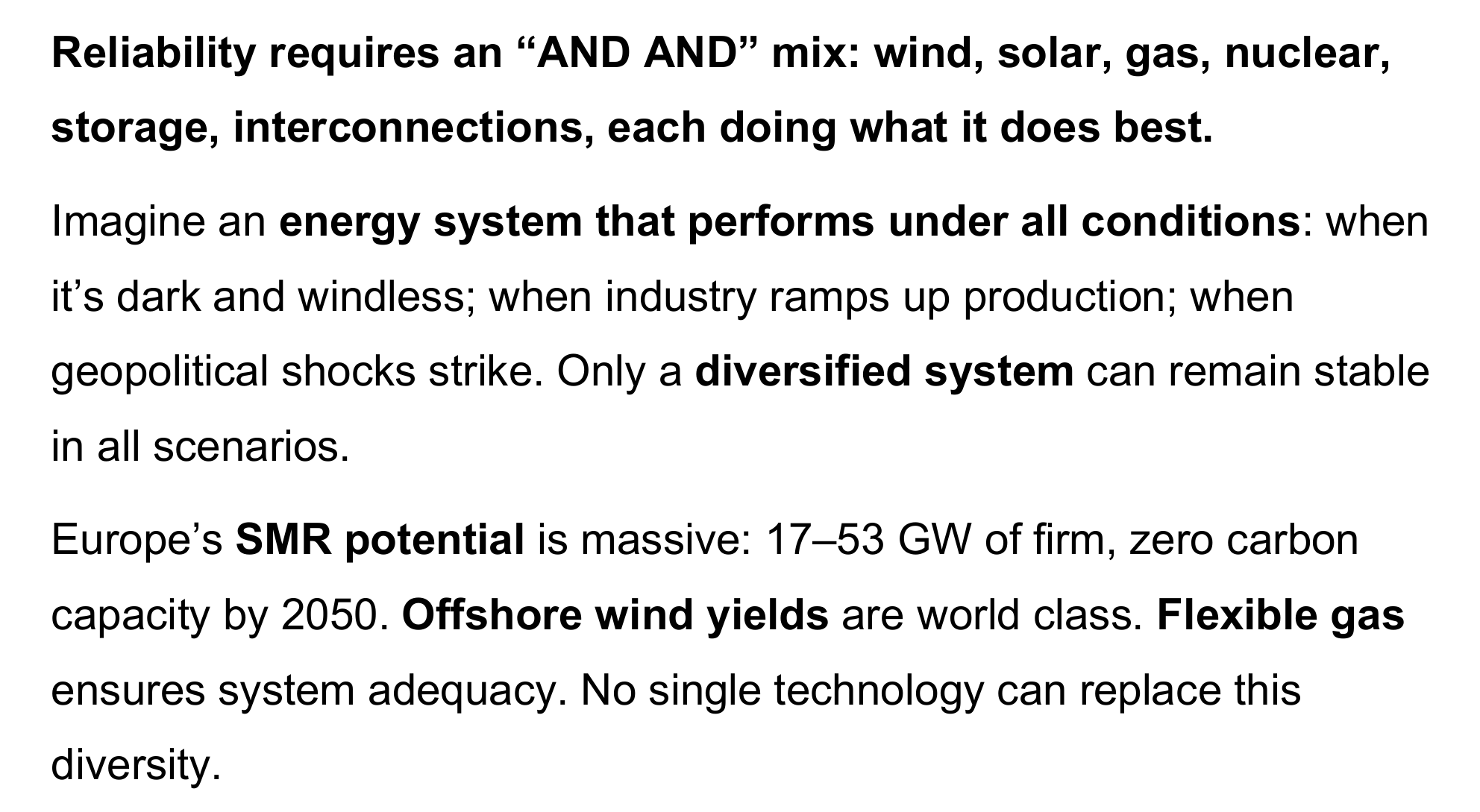
Die Unterlagen zeichnen ein Bild, nach dem Reiche die Konferenz als Plattform für einen Kurswechsel in der Energiepolitik nutzen wollte – weg vom Fokus auf erneuerbare Energien hin zu mehr Gas und Atomkraft. Reiche nutzt dafür die Worte „Realismus“ und „Pragmatismus“. Man brauche alle Arten von Energie: Wind, Sonne, Gas, Atomkraft und Batteriespeicher. So ist es in den Unterlagen mehrfach zu lesen.
Mehr als ein Dutzend Gespräche und Diskussionsrunden hat das Team aus dem Ministerium für Reiche während ihres zweieinhalbtägigen Aufenthalts geplant. Reiche soll mit dem Innenminister der USA über Gaslieferungen sprechen und mit den Ölkonzernen BP und ExxonMobil über die Auswirkungen der Methanverordnung. Zudem soll sie an einer Gesprächsrunde zu neuartigen Atomkraftwerken teilnehmen. Europas Potential dieser SMRs (small modular reactors) sei riesig, steht in den Dokumenten.
Gas und Atomkraft
Die Dokumente: geschwärzt, unvollständig, überteuert
Zu wichtigen Fragen der High-Level-Treffen der Wirtschaftsministerin in Texas geben die Dokumente jedoch keine Antwort. Zahlreiche Passagen sind geschwärzt, andere Dokumente fehlen komplett. Die Sammlung besteht vor allem aus Vorbereitungsunterlagen: Terminabsprachen, das geplante Programm für die Ministerin, Briefings für bilaterale Treffen und Panels. Was fehlt: Notizen und Protokolle der Treffen. Solche Debriefs werden von Ministerien üblicherweise erstellt, um beteiligte Referate auf dem Laufenden zu halten.
Was hat die Ministerin mit CEOs und Regierungsvertreter*innen besprochen? Welche Versprechen hat sie der Industrie gegeben? Was in Texas besprochen wurde, darf nicht geheim bleiben, denn es hat unmittelbare Auswirkungen auf die deutsche Klima- und Energiepolitik.
Deshalb haben wir beim Ministerium Widerspruch gegen den Bescheid eingelegt – genauso wie die Umweltorganisationen Greenpeace und die Deutsche Umwelthilfe (DUH). Auch sie hatten nach dem Treffen in Texas ähnliche Anfragen gestellt. Da das Ministerium auf den ursprünglichen Antrag zunächst über Monate nicht geantwortet hatte, erhob die DUH eine Untätigkeitsklage. Erst danach gab das Ministerium an alle Organisationen und zusätzlich an einen FragDenStaat-User dasselbe 92-seitige Dokument heraus – und forderte von allen jeweils den Gebührenhöchstsatz von 500 Euro.
→ zur Anfrage bei FragDenStaat
→ zu den Dokumenten
→ zum Widerspruch von FragDenStaat
Ref. XY US Secretary of the Interior Themen 1. Current geopolitical situation (impact on energy policy) 2. Energy Security 3. Energy and data centers 4. Bilateral energy cooperation Kernbotschaften 1. The U.S. and Germany share important approaches in the implementation of their energy policies 2. The German Government is placing increased emphasis on pragmatic and efficient solutions in the interest of business and citizens 3. Areas for bilateral cooperation: energy&data centers, geothermal energy, CCS, SMR

- Seite 2 -
Current geopolitical situation (Impact on Energy Policy) –
VIIIB1


  The Energy Information Administration (EIA) presented a forecast for
energy prices last week, which assumes an oil price of 79 USD/barrel brent on average
in 2026 and a gas export price that is only slightly higher compared to the previous
year-.
Also, Qatar has temporarily stopped its LNG exports to Europe (less than 4% of total
European gas imports, less than 9% of LNG Imports). A recent ifo-forecast fears that
the geopolitical development may harm German economic growth, especially if the
situation continues. Some reports indicate that demand for heat pumps and solar PV in
Germany has increased as a result of high oil prices.
  Iran co-
manages South Pars, the world’s largest gas field, with Qatar. In response, Teheran
has threatened retaliatory strikes against gas infrastructure and refineries in the UAE,
Saudi Arabia, and Qatar.


We are observing the current geopolitical escalation in the Middle
East and the closure of the Strait of Hormuz with grave concern.
While the physical security of supply in Germany remains
stable due to our successful diversification, the massive price
spikes—especially for middle distillates—are putting immense
pressure on our citizens and fueling inflationary trends across the
globe.
Over the past week, prices have eased slightly from their recent
highs of $120 per barrel for Brent crude and €60/MWh for gas on
the TTF. At present, we are seeing a period of sideways
movement:

- Seite 3 -
Oil prices are currently stabilizing in a corridor around $105 per
barrel. Gas prices are hovering in a corridor around €55/MWh.
LNG imports via German terminals are currently unaffected, as
there are no scheduled deliveries from the Middle East; our
primary volumes continue to arrive from the US. We appreciate
the reliability of our U.S. partners.
Despite this relative stabilization, oil and gas markets remain
highly volatile as there is no clear indication of how long the
conflict and the blockade in the Persian Gulf will persist. While
there is no physical shortage of fuels at this stage, we remain
concerned about the impact of high prices on diesel and jet
fuel.
To mitigate these pressures, Germany is participating in a
coordinated IEA collective action to release 400 million barrels
of emergency oil reserves, with our contribution amounting to
approximately 2.64 million tonnes.
Furthermore, we are implementing a legislative amendment to the
Act against Restraints of Competition on the German fuel
market.
How do you assess the mid-term impact of its maximum
pressure policy on Iran for global oil markets and energy price
stability?
What levers do you see for stabilizing international energy
markets?

- Seite 4 -
Energy Security–VIIIB1
Germany bets on all sources of energy: wind, solar, gas, oil,
storage interconnections, looking into nuclear – similar to the US’
“all of the above” approach.
Diversification of partners a key component of ensuring security
of supply.
How is the National Energy Dominance Council approaching the
topic of energy infrastructure, resilience and supply chain
security?

- Seite 5 -
Energy and data centers – ID1
In recent years, the US have seen a massive increase in data centers – mostly used
for powering AI. The currently installed capacity of 57 GW is set to double by the end of
the decade.

However, data center deployment comes with a specific set of challenges, ranging
from massively increased electricity demand and strain on the grid to environmental
concerns over noise pollution and problems with social licensing and increasing energy
bills for consumers.

Energy infrastructure will be the backbone of the AI industry.
America and Europe can reinforce each other: the U.S. leads in
compute, Europe leads in system integration. AI requires the
strengths of both. See room for cooperation.

- Seite 6 -
Bilateral Energy Cooperation – IIB6
The bilateral Climate and Energy Partnership (CEP) was concluded following the end
of the first Trump presidency. It was announced on 15 July 2021 by Chancellor Merkel
and U.S. President Biden; the memorandum of intent was signed on 27 May 2022 by
four co-chairs (Habeck/Baerbock/Kerry/Granholm).
The focus was on the exchange of best practices and technology cooperation,
strengthened transatlantic investment in clean technologies, and supply chains. The
goal at the time: to advance transformation in line with Paris as global "leaders". To
this end, four technical working groups were established: hydrogen, offshore wind,
zero-emission vehicles, and cooperation with third countries. In addition, a B2B
task force focusing on trade in hydrogen derivatives and a working group on CCUS.


In the EU-US Joint Statement of August 21, 2025 (framework on an agreement on
reciprocal, fair and balanced trade) energy cooperation is addressed with a focus on the
elimination of non-tariff barriers, complemented by an EU commitment expressing its
intention to purchase US LNG, oil, and nuclear energy products with an expected
offtake valued at $750 bn through 2028.

We share the approach to energy policy that focusses on
affordability and resiliency, applying pragmatism and common
sense.
Areas I am particularly interested in include geothermal energy,
small modular reactors, CCS, and of course AI and data centers
but I am happy to hear about your priorities.

Vom Leitungsbereich auszufüllen.
Eingangsdatum Leitung Tagebuchnummer eDW-Nummer
16.03.2026
Terminvorbereitung
BM'in Reiche
Betr.: Leadership Dialogue mit

  Ort: George R. Brown Convention Center, Raum:
Bridge, 3. Etage (# 360)
Für den Termin am: 25.03.2026, 15:15 - 15:55
Uhr
BM
 z.K.
 z.K.
PSt z.K.
St
Anlagen:
Anlage 2: Gesprächsteilnehmende mit Foto und Kurzlebenslauf
Anlage 3: Sprechpunkte
Teilnehmer/innen:
  S&P Global
Kontaktpersonen vor Ort:
 IIB6
Aktenzeichen
Bearb. RL Mitz. UAL AL

Ablauf: Begrüßung durch den Host und Gespräch Anlass/Rahmen: Vorbereitung für den Leadership Dialogue mit im Rahmen der CERAWeek. Sprachregime: Englisch Folgende Themen wurden angemeldet / sind zu erwarten: 1. Energy Realism 2. Restoring competitiveness 3. The global race for AI Kernbotschaften 1. Energy realism : Europe needs to acknowledge that for the foreseeable future expanding intermittent renewables needs to be combined with flexible baseload capacity – including storage capacities – and intelligent grid and system integration to power its economy. 2. Europe has all it needs to restore its competitiveness – especially in the global AI race. The grid is the central economic asset of a modern industrial nation. Europe already runs the grid architecture the AI era requires: highly connected, balanced across borders, digitalised, and capable of integrating both renewables and hyperscale loads. 3. AI is only as powerful as the energy system beneath it. But it is not all about competition. Cooperation is not a zero-sum game but creates win-win opportunities. Therefore, we need a transatlantic energy - AI compact.

--- Anlage 2: Gesprächsteilnehmende mit Foto und Kurzlebenslauf --- S&P Global

--- Anlage 3: Sprechpunkte ---
Energy Realism
Realism, pragmatism and geopolitical resilience are the three key
elements of my energy policy.
Europe needs to acknowledge that, for the foreseeable future,
expanding intermittent renewables needs to be combined with
flexible baseload capacity to power its economy.
This includes storage capacities, intelligent grid and system
integration.
Imagine a modern industrial nation trying to run an AI economy as well
as steel, chemicals, and transport on weather dependent supply, with
insufficient backup, insufficient transmission, and insufficient planning. It
cannot work.
Europe operates the largest, most interconnected electricity grid in the
world: with 400+ cross border interconnectors serving 600 million
people, enabling real time balancing across an entire continent.
This level of integration creates resilience, stabilizes prices, and
allows Europe to move renewable energy and firm power efficiently
across borders.
Germany is moving to factual, engineering based energy policy. A clear-
eyed view of reality is the only path to competitiveness, climate progress,
and industrial strength.
My policy stands for a pragmatic “and and” transition.

Zur nächsten Seite
PakarPBN
A Private Blog Network (PBN) is a collection of websites that are controlled by a single individual or organization and used primarily to build backlinks to a “money site” in order to influence its ranking in search engines such as Google. The core idea behind a PBN is based on the importance of backlinks in Google’s ranking algorithm. Since Google views backlinks as signals of authority and trust, some website owners attempt to artificially create these signals through a controlled network of sites.
In a typical PBN setup, the owner acquires expired or aged domains that already have existing authority, backlinks, and history. These domains are rebuilt with new content and hosted separately, often using different IP addresses, hosting providers, themes, and ownership details to make them appear unrelated. Within the content published on these sites, links are strategically placed that point to the main website the owner wants to rank higher. By doing this, the owner attempts to pass link equity (also known as “link juice”) from the PBN sites to the target website.
The purpose of a PBN is to give the impression that the target website is naturally earning links from multiple independent sources. If done effectively, this can temporarily improve keyword rankings, increase organic visibility, and drive more traffic from search results.